

Padel's popularity is bigger than Spain and Argentina now. The sport has a real global footprint, with new courts, clubs, leagues, and social formats pulling in players who used to split their time between tennis, squash, and pickleball.
Want a quick answer? Padel has roughly 19.4 million players worldwide in the Playtomic and PwC Strategy& 2026 estimate, while the International Padel Federation's 2025 reporting points to more than 35 million active players. The exact number depends on how each source defines an active player. The direction is clear: courts, clubs, federation membership, and amateur participation are all rising.
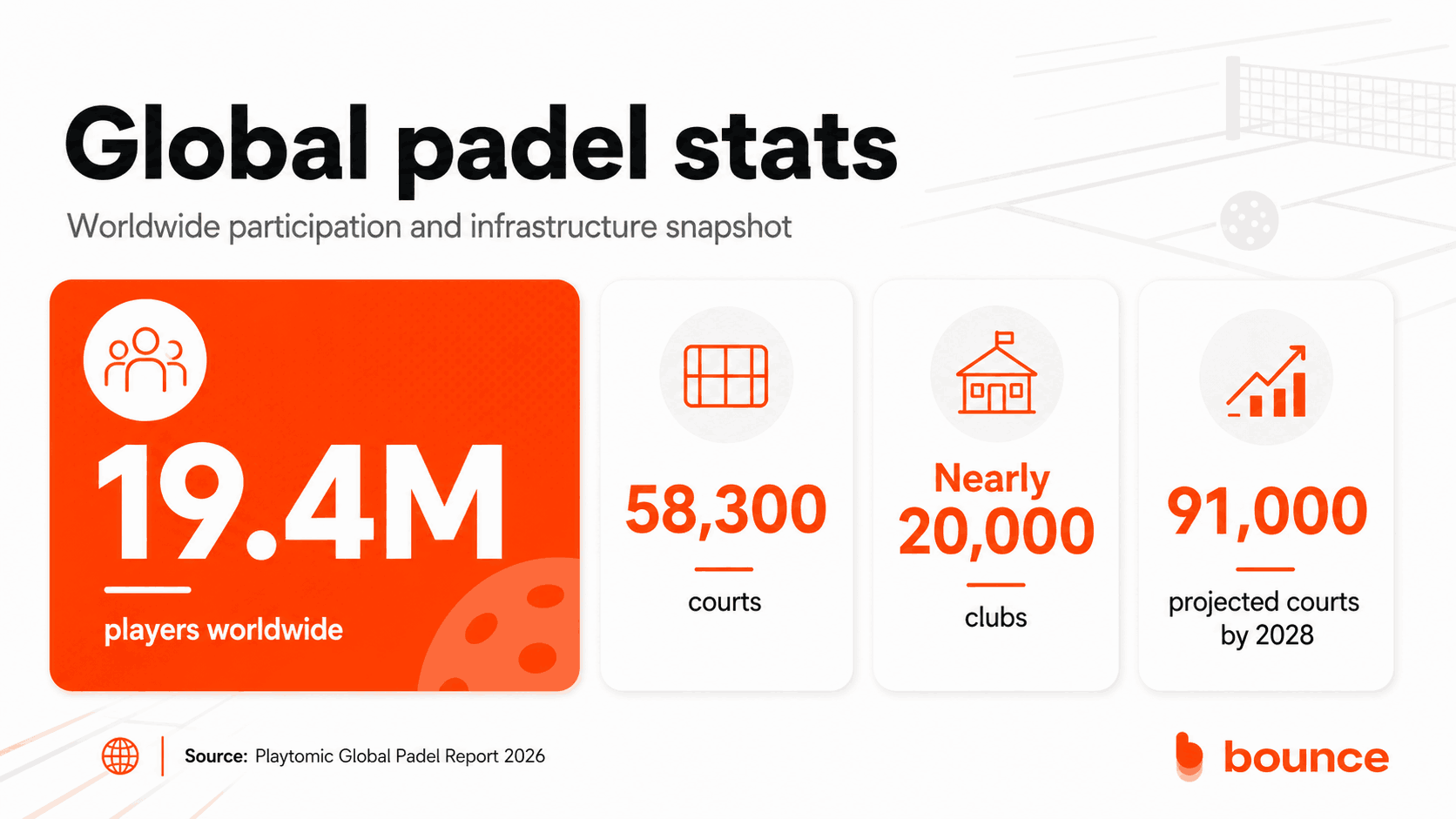
Padel is popular enough to support tens of thousands of courts worldwide. Playtomic and PwC estimate 58,300 courts, nearly 20,000 clubs, and 19.4 million players globally, with courts projected to reach 91,000 by 2028.
How many people play padel worldwide?
Playtomic's Global Padel Report 2026 estimates 19.4 million players worldwide, with 58,300 courts and nearly 20,000 clubs. That is the cleanest current commercial snapshot because it connects players, clubs, and court infrastructure in one view.
FIP World Padel Report 2025 points to a larger participation signal, with more than 35 million active players referenced in FIP's report communications. Those two numbers can both exist because participation is measured differently across federations, booking platforms, and club operators.
So I would treat 19.4 million as the more conservative operator-data estimate and 35 million-plus as the broader federation participation signal. The useful takeaway is the same: padel has moved past niche status.
Why court growth matters more than hype
Padel growth is physical. You can talk about search demand and social clips all day, but players need glass courts. That makes court count the clearest signal of whether a market is actually opening up.
Playtomic and PwC put the global court count at 58,300 and project 91,000 courts by 2028. That projection says the next phase is about facilities, real estate, club operations, and repeat play.
Bounce helps players find courts, open play, socials, and leagues as padel supply grows city by city. That matters because new courts only become real participation when players can find the right session at the right level.
Padel court growth matters because every new market needs dedicated glass courts. More courts create more booking slots, more beginner sessions, more leagues, and more reasons for players to come back.
Padel growth in the U.S.
FIP's U.S. growth update estimated that the U.S. would exceed 650 courts across 175 clubs in 31 states by early 2025. Florida led the count with 268 courts, about 41% of the national total. Texas followed with 18%, California with 10%, and New York with 4.7%.
The professional side is growing too. FIP reported 1,917 licensed U.S. professional players in 2024, up 10% from the prior year, and more than 100,000 amateur players.
The Padel Paper reported that the U.S. passed the 1,000-court mark in 2026, with padel present in 37 states. It also cited USPA expectations of 20,000 courts and 15 million U.S. players by 2030. Treat that 2030 figure as a forecast, not a current count.
If you are trying padel for the first time, Bounce can help you find beginner-friendly open play, socials, coaching, and leagues in your city.
The UK shows what mainstream adoption can look like
LTA Padel reported 860,000 adults and juniors played padel at least once in Great Britain in 2025. That is up from 400,000 in 2024 and 129,000 in 2023.
Court supply rose with demand. The LTA reported 1,553 courts across 559 venues at the end of 2025, up from 870 courts across 293 venues one year earlier.
That UK pattern is useful for the U.S. because it shows how quickly participation can move when courts, clubs, beginner access, and cultural visibility arrive together.
Padel participation in Great Britain more than doubled in 2025, reaching 860,000 players. Courts also rose to 1,553 across 559 venues, according to LTA Padel.
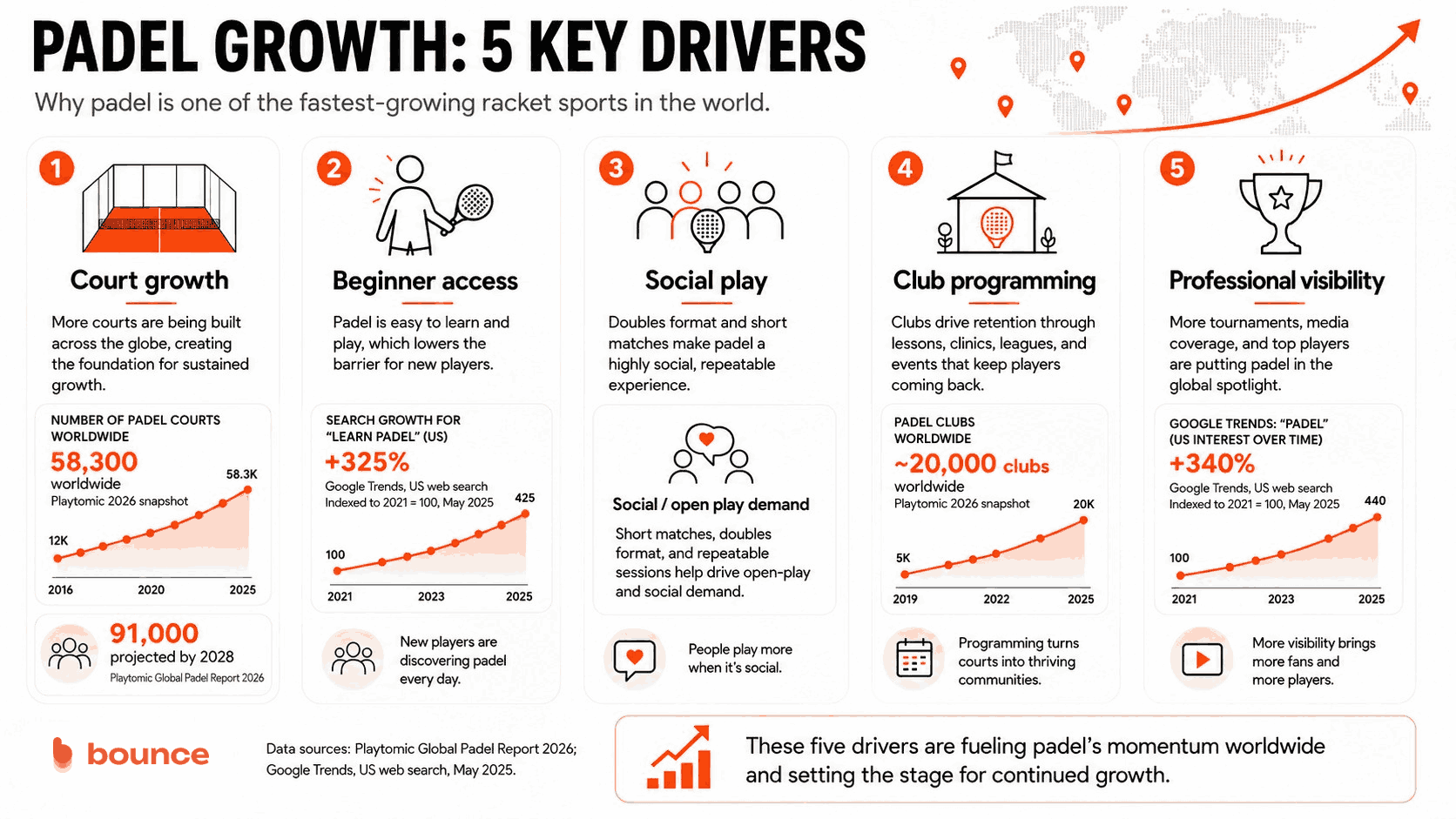
The 5 trends behind padel's growth
| Trend | What is happening | Why it matters |
| Beginner access | The underhand serve and smaller court shorten the first-session learning curve. | New players can rally sooner. |
| Doubles format | Most play happens with 4 players. | The sport feels social by design. |
| Club programming | Open play, clinics, socials, leagues, and ladders create repeat visits. | Programming turns curiosity into habit. |
| Real estate interest | Padel courts fit into clubs, rooftops, mixed-use projects, and converted spaces. | More venue types can support supply. |
| Professional visibility | Premier Padel, FIP events, and national tours create a clearer competitive path. | Competitive players have more to follow. |
Padel vs pickleball growth: the U.S. comparison
In the U.S., pickleball still has the larger base and the deeper public-court footprint. Padel is earlier in its growth curve because it needs purpose-built glass courts, which are more expensive and less common.
That slower supply build can actually protect the quality of the experience. Padel growth is more tied to clubs, organized sessions, and paid programming, which can make the first few months feel more structured.
Padel vs pickleball is the comparison many U.S. players ask first because both sports promise easier entry than tennis. The growth mechanics are different: pickleball spreads through low-cost courts, while padel spreads through clubs and facility investment.
What growth means for new players
More padel courts should mean easier access, but it also means the quality of local programming will matter more. A city can have courts and still feel hard to enter if beginners cannot find the right session.
Look for beginner open play, mixed-level socials, coaching clinics, and leagues that separate players by experience. That is how padel avoids becoming a sport people try once and forget.
Padel equipment is also worth getting right early. You need a padel racket, padel balls, and shoes that suit the court surface. The wrong gear makes a simple sport feel awkward.
What growth means for clubs and coaches
For clubs, the demand signal is strong, but courts alone will not carry the business. Padel works best when clubs package the experience: beginner nights, clinics, rating-based play, recurring socials, and leagues.
For coaches, the opportunity is early. New players need rules, positioning, glass reads, serve basics, and confidence in doubles movement. The sport is simple to start, then technical enough to reward coaching.
Padel tips can help new players avoid the usual first-month mistakes, especially standing too deep, swinging too big, and treating the walls like a panic button.
The bottom line
Padel popularity is being built on 2 things: playable first sessions and fast-growing court supply. The sport feels social immediately, and the business side is finally catching up in markets outside Spain and Argentina.
The U.S. is still early compared with Europe, but the direction is strong. Courts are spreading, amateur participation is rising, and organized play is becoming easier to find.
For players building their game through structured coaching and organized play, Bounce connects you with coaches, courts, socials, open play, and competitive formats in your city.
Frequently asked questions
How popular is padel worldwide?
Playtomic and PwC estimate 19.4 million players worldwide in 2026. FIP's broader reporting points to more than 35 million active players. The difference comes from how each source defines active participation.
How many padel courts are there worldwide?
Playtomic and PwC estimate 58,300 padel courts worldwide and project 91,000 courts by 2028. Court count is one of the best signals of real market growth because padel needs dedicated glass courts.
Is padel growing in the United States?
Yes. FIP estimated more than 650 courts across 175 clubs in 31 states by early 2025. In 2026, U.S. reporting pointed to more than 1,000 courts and a presence in 37 states.
Why is padel becoming so popular?
Padel is easier to start than tennis, more social than many singles sports, and structured around doubles. The underhand serve, smaller court, and glass walls help beginners rally sooner.
Which countries are growing fastest in padel?
Spain and Argentina remain mature padel markets, while the U.S., UK, Italy, Sweden, the Middle East, and parts of Asia are drawing more investment. Growth depends heavily on court supply.
Will padel keep growing?
The strongest near-term signal is court supply. Playtomic and PwC project 91,000 courts worldwide by 2028, which suggests clubs and investors still see room for demand.


