

Pickleball scoring is serve-based: only the serving team earns points. Most games go to 11, win by 2, and competitive matches are played best-of-three. USA Pickleball sets these standards for all sanctioned play, from casual open sessions to the competitive leagues.
Learning how pickleball scoring works does more than help you “keep track of the numbers.” It improves match flow, reduces disputes, strengthens communication with partners, and allows you to focus on strategy instead of stopping mid-game to ask, “Wait… who’s serving?”
This guide breaks down pickleball scoring step-by-step with clear explanations and real-game examples for both singles and doubles.
The basics of pickleball scoring
How points are scored in pickleball
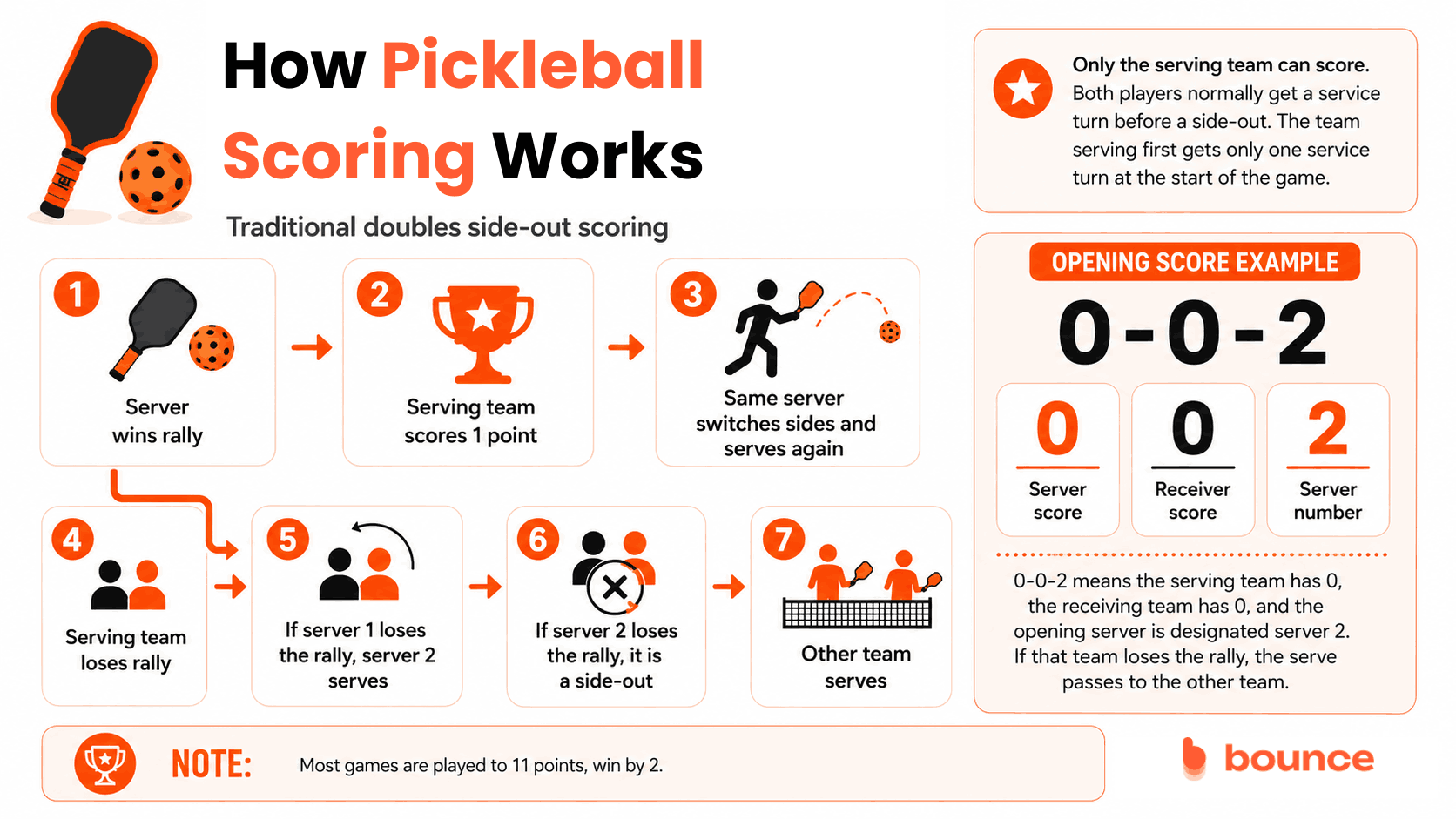
Pickleball traditionally uses serve-based scoring, meaning: Only the serving team can score points.
If the serving team wins the rally, they earn a point and continue serving. If the receiving team wins the rally, they do not get a point – instead, they gain the serve (or force the serve to pass to the second server in doubles).
This scoring system shapes how pickleball is played. It rewards consistency, patience, and smart shot selection because winning rallies while serving is the only way to build your score.
Most games are played to 11 points, and the winner must win by at least two points (for example, 11–9, 12–10, 13–11).
Competitive matches are often best-of-three games:
- Game 1 to 11
- Game 2 to 11
- Game 3 (if needed) to 15 (Win by two still applies.)
What ends a rally? (faults)
Any fault ends the rally immediately. If the server faults, the serve transfers to the second server or triggers a side-out. If the receiver faults, the serving team earns a point.
Common faults include:
- Ball lands out of bounds or in the kitchen on a serve
- Ball fails to clear the net
- Player volleys from inside the non-volley zone (kitchen violation)
- Ball bounces twice before being returned
- Return of serve is volleyed before it bounces (double-bounce rule)
- Illegal serve: wrong motion, wrong service court, or foot fault
Game length and match formats
Most games last 10 to 20 minutes recreationally. Competitive matches run longer because errors are fewer and rallies are closer.
Common match formats include:
- Single game to 11 (typical recreational play)
- Best-of-three games (most competitive play)
- Tournament formats such as round-robin pool play, brackets, and consolation rounds
The serve-only scoring system tends to make games slightly less predictable in length than rally scoring formats, because points depend heavily on serve retention.
Pickleball Scoring in Singles
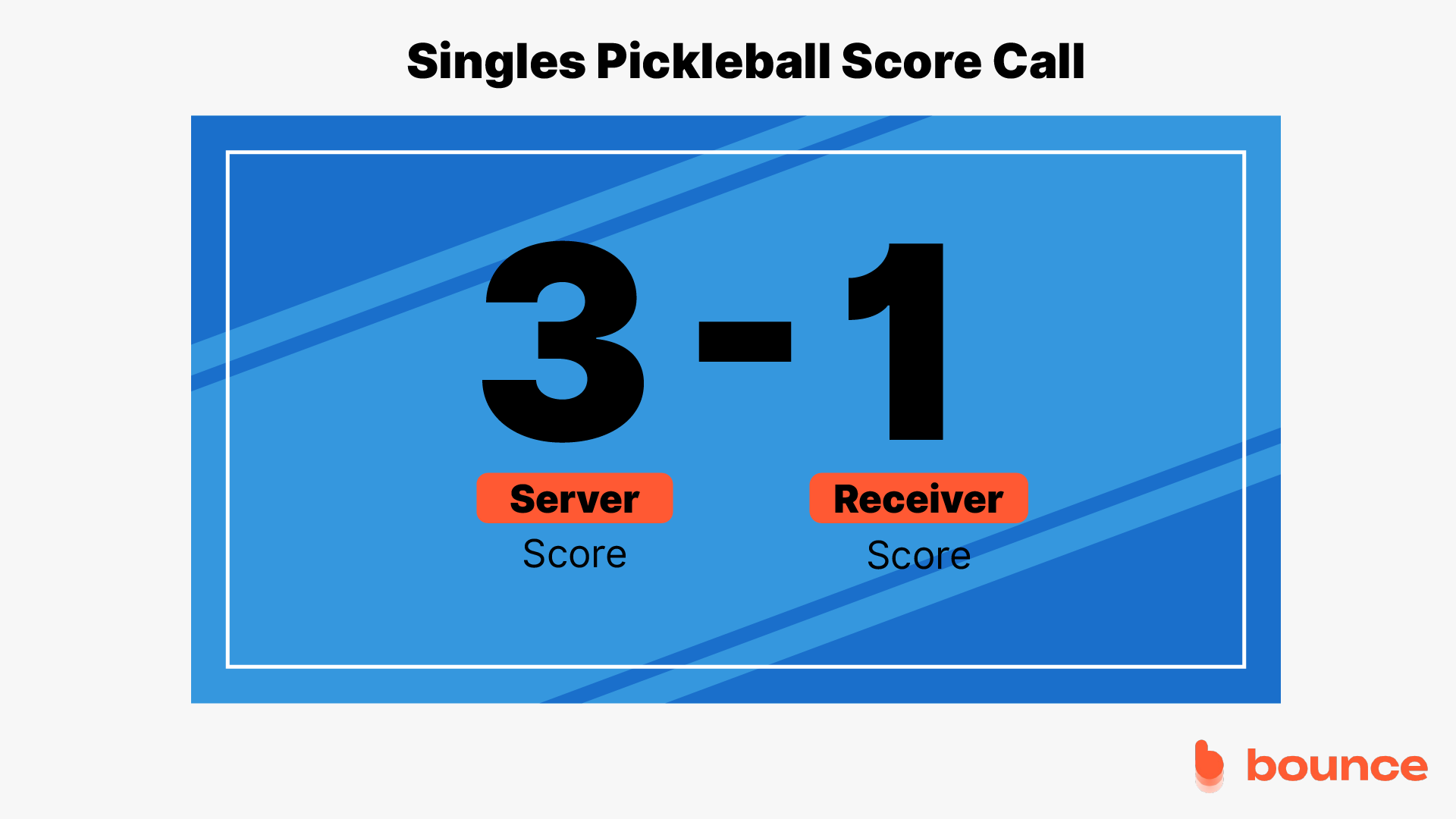
Singles uses a two-number score: your score first, then your opponent's. Only the server scores, and the serve switches to the opponent after every lost rally.
Example:
- 6–4 means the server has 6 points and the receiver has 4 points.
As in all traditional pickleball formats: Only the server can score points.
If the server wins the rally, they get a point and serve again. If the server loses the rally, the serve immediately switches to the opponent.
Singles scoring feels more intuitive for many beginners because there is no “second server” and no shared responsibility – one player serves until they lose the rally.
Serving and Side Changes in Singles
Use your score as a court position cue: even score, serve from the right; odd score, serve from the left.
- Even score → serve from the right side
- Odd score → serve from the left side
This rule makes singles easier to track because court position acts like a built-in score check. If you’re serving from the left, your score must be odd.
Singles Service Rotation
- Win the rally → score a point → switch sides → serve again
- Lose the rally → opponent gets the serve
Because singles requires full-court coverage, scoring awareness matters more than many players realize. If you forget your score or serve from the wrong side, it affects positioning and can lead to unnecessary faults or confusion.
Pickleball Scoring in Doubles
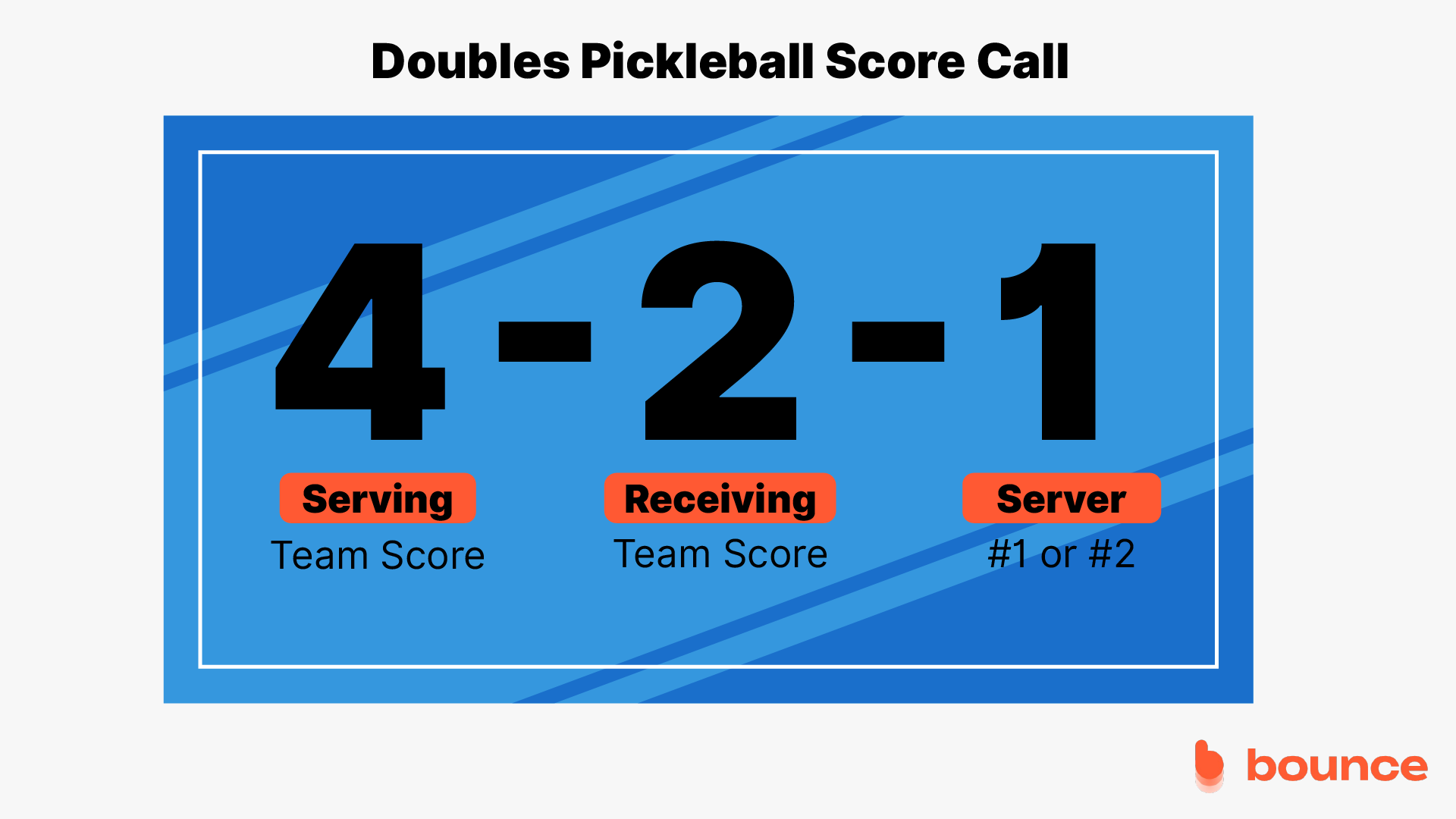
Doubles uses a three-number score: serving team's score, receiving team's score, and the server number (1 or 2). That third number tells you whether your team still has a second serve before losing possession.
Serving team score – Receiving team score – Server number
Example:
- 7–5–1 means:
- serving team has 7
- receiving team has 5
- the first server is serving
The third number matters because each team typically has two servers before the serve switches to the other team.
For a complete breakdown of doubles positioning and scoring rules, see pickleball doubles rules.
Server Rotation and Side-Outs (How Doubles Actually Works)
Each team gets two serves per turn. Lose both and it's a side-out while the other team takes the serve.
Here’s the key sequence:
- First server serves until they lose a rally → serve passes to their partner
- Second server serves until they lose a rally → side-out occurs
- Side-out means the other team now serves
Side-out = your team loses the serve completely and the other team gets it.
Why the Game Starts at 0–0–2
The first serving team only gets one serve to start. That single player is treated as the second server, so the opening score is announced as 0–0–2.
0–0–2
This rule exists to prevent the team that serves first from getting an unfair advantage. If both players served right away, the first team could potentially score points with two servers before the other team ever serves.
After the first side-out, both teams then have two servers per service turn for the rest of the game.
Doubles Side Switching Rule (Very Important)
In doubles:
- when the serving team scores a point, they switch sides (right ↔ left)
- the same server continues serving
- the receiving team stays on the same side
This is why doubles feels “busy” at first – players are rotating, switching sides, and tracking server numbers all at once.
In organized play environments such as leagues and open play sessions found through Bounce, repeated exposure to doubles scoring helps players internalize these rotations quickly and naturally.
The Pickleball Serve and Its Role in Scoring
Only the serving team can score, so a consistent serve directly protects your ability to earn points.
Who Serves First?
The first serve of a pickleball game is commonly decided by:
- a coin flip
- a rally to start
- informal agreement
The team that serves first begins under the special “one-server start” rule described above.
Serving Rules That Directly Affect Scoring
Because only the serving team can score, service consistency is extremely valuable at every level. Even strong players lose momentum when their serves create avoidable faults.
Basic serving rules include:
- the serve must be underhand: see pickleball serving rules for the full legal serve requirements
- contact must be below the navel
- at least one foot must stay behind the baseline at contact
- the serve must land diagonally in the correct service box
- the serve must clear the kitchen (non-volley zone), including the kitchen line
A service fault ends the rally immediately and causes either a loss of serve or a side-out.
Coached instruction reinforces serving mechanics and scoring awareness at the same time, which is why lessons often lead to faster improvement than casual play alone.
Official Pickleball Scoring Rules (Quick Summary)
USA Pickleball governs all official scoring rules, ensuring consistency across recreation, leagues, and tournaments.
Key scoring rules to remember:
- only the serving team can score points
- most games are played to 11, win by 2
- doubles uses a three-number score (including server number)the double-bounce rule applies to every rally after the serve
- kitchen violations, foot faults, and illegal serves end rallies immediately
These rules create a sport that rewards control, consistency, teamwork, and decision-making over raw power.
Pickleball Scoring Examples (Step-by-Step)
Doubles Pickleball Scoring Example
Game start:
- Score begins at 0–0–2
- First server serves from the right side
Sequence:
- Serving team wins rally → scores a point → 1–0–2
- Server switches sides and serves again
- Serving team loses rally → side-out occurs (because only one server starts)
Now the other team serves with two servers available.
Later in the game:
- Score reaches 6–4–1
- first server loses rally → serve passes to second server
- second server loses rally → side-out occurs
- the serve switches to the opposing team
This example shows why the server number matters: it tells you whether your team still has a second serve available before losing possession.
Singles Pickleball Scoring Example
Game start:
- Score begins at 0–0
- server serves from the right side (even score)
Sequence:
- server wins rally → score becomes 1–0
- server now serves from the left side (odd score)
- server loses rally → opponent gains serve → score called 0–1
This back-and-forth continues until someone reaches 11 and wins by two.
Tournament Pickleball Scoring Explained
Tournament scoring follows the same serve-only rules as recreational play. The difference is that scoring errors carry real consequences: wrong serve rotation can affect standings and advancement.
Common tournament formats include:
- single elimination
- double elimination
- round-robin pool play
Games are often played to:
- 11 in earlier bracket rounds
- 15 in medal rounds or specific divisions (Win-by-two still applies unless the event rules state otherwise.)
Digital platforms like Bounce help streamline tournament play by centralizing schedules, match formats, and communication, reducing confusion for organizers and players.
Rally Scoring vs Traditional Pickleball Scoring
Traditional scoring only awards points to the serving team. Rally scoring gives a point to whoever wins the rally, regardless of who served.
Rally scoring is occasionally used in:
- Time-limited recreational sessions
- Experimental formats
- Instructional settings
While rally scoring speeds up games, it fundamentally changes strategy by increasing risk tolerance and reducing the importance of serve retention.
Traditional scoring remains the standard for competitive and sanctioned play due to its emphasis on consistency and serve management.
The table below highlights the key differences between traditional pickleball scoring and rally scoring, focusing on how each system affects gameplay, strategy, and match structure.
| Scoring Aspect | Traditional Pickleball Scoring | Rally Scoring |
| Who Can Score a Point | Only the serving side | Either side can score |
| Serve Importance | High – losing the serve stops scoring | Moderate – serve does not control scoring |
| Game Length | Variable, often longer | More predictable and faster |
| Strategic Emphasis | Patience, consistency, serve management | Aggression, rally control |
| Common Usage | Standard recreational and tournament play | Time-limited or experimental formats |
| Win Condition | Typically first to 11, win by 2 | Often fixed-point or timed formats |
| Momentum Swings | Slower, controlled by serve retention | Faster, frequent shifts |
| Official Standard | Yes, used in sanctioned play | No, rarely used in official competition |
Understanding both formats helps players adapt across different play environments.
Conclusion
Pickleball scoring is more than a set of numbers announced before a serve – it shapes strategy, momentum, and how players manage risk throughout a match. Players who understand scoring clearly make fewer mistakes, communicate better with partners, and perform more confidently under pressure.
The fastest way to master scoring is repetition in structured environments. Lessons,leagues, tournaments, and organized open play reinforce correct habits naturally. Bounce ssupports that process by connecting players with certified coaches, competitive matches, and communities where accurate scoring is part of every game.
With a strong foundation in pickleball scoring, you’ll spend less time confused about serve rotation – and more time focused on playing smarter, improving faster, and enjoying every match.
Frequently asked questions
How is scoring done in pickleball?
In traditional pickleball, only the serving team can score. Win a rally while serving and you earn one point; lose a rally while serving and the serve changes hands. Games typically go to 11, win by 2. Doubles uses a three-number score (team score, opponent score, server number); singles uses two numbers.
Is pickleball played to 11 or 15?
Most games go to 11, win by 2. In tournament play, medal rounds are often played to 15, also win by 2. The third game in a best-of-three match is typically played to 15 as well. Some tournament formats use 15 throughout.
What is the easiest way to remember the score in pickleball?
In singles, use your court position as a cue: even score means serve from the right, odd score means serve from the left. In doubles, announce the full three-number score out loud before every single serve. Saying it aloud every time is how experienced players catch rotation errors before they compound.
How many times can you serve in pickleball?
One serve attempt per turn (no second serves as in tennis). In doubles, each team gets two server turns per rotation (server 1 and server 2) before a side-out. The exception is the start of the game: the first serving team only gets one serve before the other team takes over.
What is Nasty Nelson in pickleball?
A Nasty Nelson is a serve intentionally aimed at the non-receiving player standing near the centerline. If the ball hits them, the serving team wins the point. It's a legal tactic, though uncommon in serious play. The name comes from pro player Timothy Nelson, who popularized it at the recreational and amateur level.


